Ham Radio Operator - M0YKS
Ham Radio Experiments & Fun With Simon M0YKS Yorkshire UK

Sunday, January 08, 2023
Working Into FO-118 CAS-5A
Greetings from the shack of M0YKS, I hope the New year has started well for you. I have been active on most bands from 80m through to 70cms. DX on 10m has been awesome so has 12, 15 and the other HF bands, my confirmed DXCC is now at 155 on QRZ using SSB phone mode. Hopefully this year I will improve the logged DXCC but either way I am enjoying the chase. 
I have also been active on the Satellite bands working mostly into Europe on both SSB and the FM birds. 
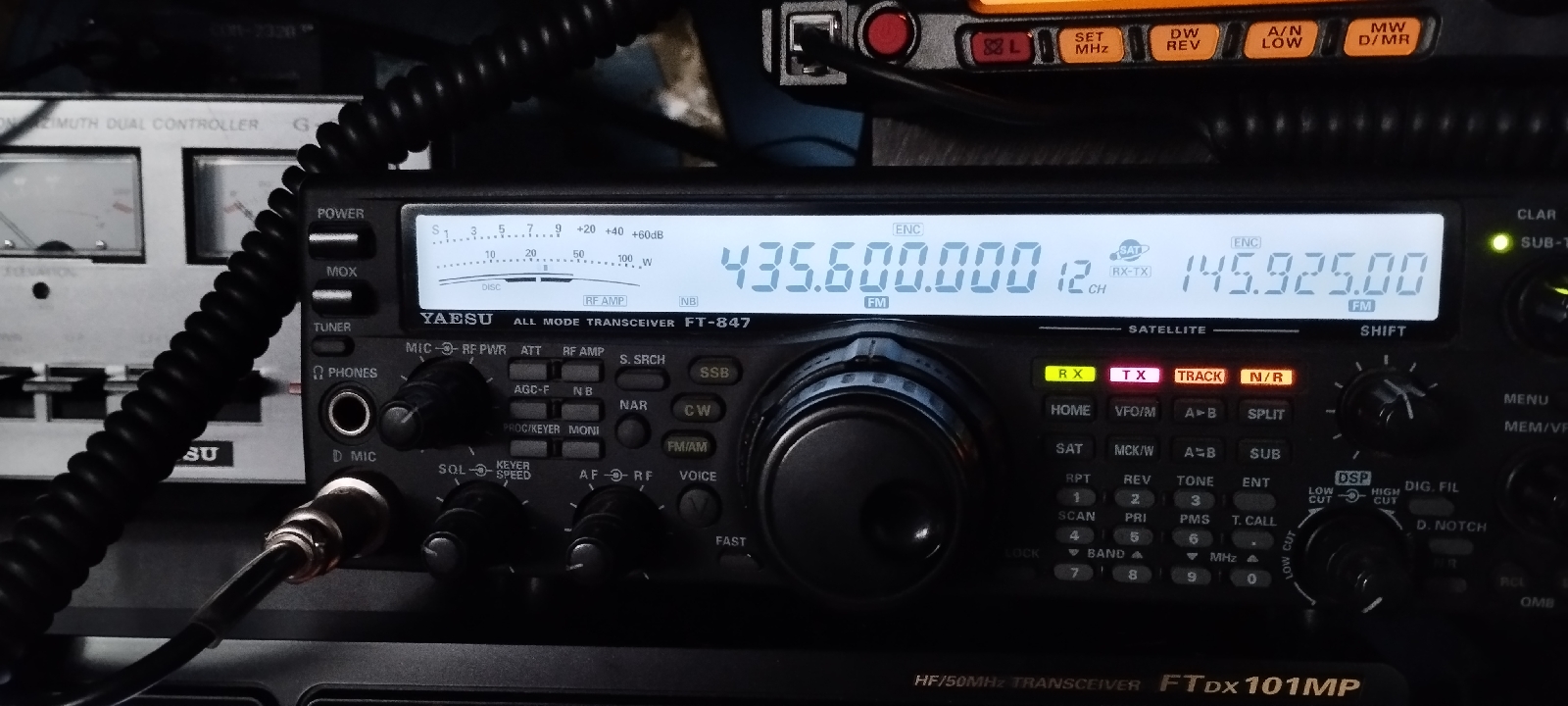
Today I thought I would have a go at working a reasonably new Satellite CAS 5A also known as FO-118. I haven't quite setup my radio steering software SATpc32 correctly with the Doppler correction known as a Doppler sqf file yet, so I had to manually change the downlink frequency but still managed a few nice QSOs. The new Satellite was built by CAMSAT and has a FM V/u repeater as well as V/u and interestingly a H/u linear transponder on board for amateur radio use. 
If you don't quite understand what it all means this is it: V = VHF, U = UHF and H = HF. So for example in the case of V/u it would mean VHF uplink TX and UHF down link RX. For this Satellite CAS 5A, V/u is 145.925 FM TX and 435.600 FM RX. 
Today's first trial of working the bird proved to be easy enough with a decent signal back down from the bird using the FM repeater. The next thing is to try the linear transponders and maybe operate the H/u mode with a 15m band uplink. That will be something new for me for sure. The V/u SSB transponder should be easy enough to hit and probably will be decent if it is anything like the earlier XW Chinese satellites. Hope to hear you soon from IO93CU. H N Y.

Labels:

posted by MØYKS Simon @ January 08, 2023   1 comments
Sunday, February 15, 2015
Weather Satellite Decoding - NOAA-19

Weather Image Received From NOAA-19

I recently changed my computer and replaced it with the acer Aspire XC-115 mini tower. The PC is very fast and has all the required bells and whistles with the latest windows 8.1 operating system. The program that I normally use for decoding (radiocom 5.2) was designed for XP and is a bit old for the latest operating system so I decided to try another well known satellite decoder known as WXtoImg.
 I downloaded the latest window 8 version which seems to be working quite well as I caught a pass earlier this afternoon from NOAA 19. The decoded image above was received via my FT-847 and satellite antenna, the frequency used was 137.100 MHz.

Labels: , ,

posted by MØYKS Simon @ February 15, 2015   0 comments
Saturday, December 10, 2011
Today's NOAA 19 Weather Image For UK, Spain & France
Today's NOAA 19 weather satellite image recieved at my ham radio station in Yorkshire UK at 13.55 UTC. Equipment Used: Yaesu FT-847, Radiocom 5.2 Decoder, 5 element Yagi, G-5500 Elevation/Azimuth Rotator. The UK can be seen with lots of cloud cover at the middle right hand side of the decoded image.

Labels: , , , ,

posted by MØYKS Simon @ December 10, 2011   0 comments
Tuesday, October 04, 2011
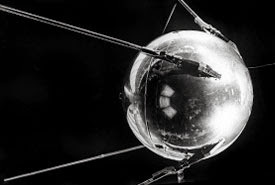
Happy Birthday Sputnik

It's 54 years since the launch of the Russian satellite Sputnik. Launched on Oct 4, 1957 Sputnik paved the way for satellite communications which has been enjoyed by many radio amateurs around the world.

Named after the Russian word for satellite Sputnik was 22 inches in diameter and thanks to heavy batteries weighed 184 pounds. According to Wikipedia:

"The satellite had a one-watt, 3.5 kg (7.7 lb) radio transmitting unit inside, developed by V. I. Lappo from NII-885, that worked on two frequencies, 20.005 and 40.002 MHz. Signals on the first frequency were transmitted in 0.3 sec pulses (under normal temperature and pressure conditions on-board), with pauses of the same duration filled by pulses on the second frequency. Analysis of the radio signals was used to gather information about the electron density of the ionosphere."

The satellite travelled at a whopping 18,000 miles an hour. Its elliptical orbit varied from between 584 miles and 143 miles from the Earth which it circled once every hour and 36 minutes.

As well as technologically paving the way for satellite communications Sputnik heralded an important era of the Cold War, heightening tensions between the US and Russia which would take many years to thaw. Now on the ham bands Russians and Americans share many happy QSOs and rather than being a signal of suspicion and discontent Sputnik is seen as a key point in Ham Radio history.

So, Happy Birthday Sputnik! I hope to be making some satellite QSOs in your honour to celebrate!

Labels: , , ,

posted by MØYKS Simon @ October 04, 2011   0 comments
Custom Search


About Me

Name: MØYKS Simon
Home: Baildon, West Yorkshire, United Kingdom
About Me:
See my complete profile
Previous Post
Archives
Links
Powered by


free counters
>
BLOGGER